Every commercial kitchen generates grease-laden vapor, and that vapor doesn’t disappear once it leaves the cooking surface. It travels up through the hood and into the duct system, where it cools and accumulates on every surface it touches. Left unaddressed, that buildup is one of the most common causes of restaurant fires, and it’s exactly why cleaning frequency isn’t left up to guesswork.
NFPA 96, the standard governing ventilation control and fire protection for commercial cooking operations, sets cleaning intervals based on cooking volume and type rather than a single blanket schedule. High-volume operations like 24-hour kitchens or those cooking with solid fuel typically need monthly cleaning. Most full-service restaurants fall into a quarterly cleaning interval, while lower-volume operations, like seasonal businesses or facilities with lighter cooking loads, may be able to extend to semi-annual service. The deciding factor is how quickly grease actually accumulates in your specific system, not a one-size-fits-all calendar.
It’s easy to think of hood and duct cleaning as a formality for passing inspection, but the buildup itself is the actual hazard. A duct lined with grease is essentially a fuel source connected directly to your cooking equipment, and a fire that ignites in that environment can spread through the ductwork far faster than a fire confined to the cook line. Regular cleaning isn’t about satisfying a fire marshal; it’s about removing the fuel before it becomes a problem.
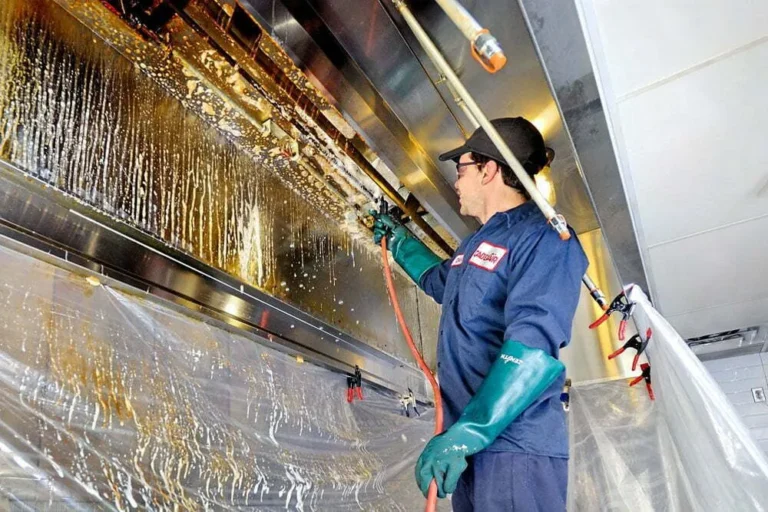
A complete service goes beyond a quick wipe of the visible hood surface. It should include the hood itself, the ductwork running to the roof or exterior wall, the fan housing, and all accessible portions of the exhaust system, since grease accumulates throughout the entire path, not just where it’s easiest to see. Our restaurant hood and duct cleaning service covers the full system for exactly this reason, along with grease filter exchanges on whatever schedule, weekly, bi-weekly, or monthly, matches your kitchen’s actual cooking volume.
Grease filters need attention far more often than the full duct system itself. A filter that’s allowed to clog doesn’t just reduce ventilation efficiency, it also lets more unfiltered grease vapor reach the ductwork beyond it, which speeds up the buildup you’re already paying to have removed. Keeping filters on a tighter rotation is one of the simplest ways to extend the interval needed between full system cleanings.
Hood and duct cleaning is one piece of a kitchen’s overall fire protection setup, but it works alongside the suppression system mounted above your cooking equipment and the extinguishers placed throughout your kitchen. All of these systems are part of the comprehensive fire protection services we provide to restaurants and commercial kitchens across the Chicagoland area, Indiana, and Wisconsin, and it’s worth having all three evaluated together rather than treating them as separate, disconnected maintenance items.
If you’re not sure what cleaning interval your kitchen actually needs, or it’s been longer than it should be since your last service, reach out to Foster & Son Fire Protection at 708-233-9505 and we’ll get your system on a schedule that matches how your kitchen actually operates.