
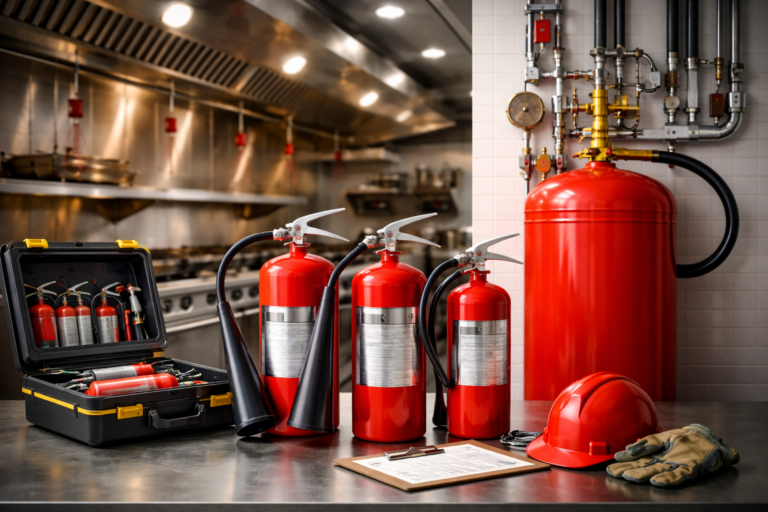
Fire extinguishers are one of the simplest pieces of fire protection equipment in any building, which is exactly why they’re easy to overlook. A property can have a fully functional, code-compliant suppression system overhead and still fail an inspection because the extinguishers themselves weren’t maintained, tagged, or placed correctly. Here’s what compliance actually involves for commercial properties across Illinois, Indiana, and Wisconsin.
Not every extinguisher is suited to every fire. Class A extinguishers handle ordinary combustibles like wood and paper, Class B covers flammable liquids, Class C is rated for electrical fires, and Class K is specifically designed for the high-temperature cooking oil fires found in commercial kitchens. A property with the wrong class of extinguisher in a given area isn’t just a compliance issue, it’s an extinguisher that may actually be ineffective, or unsafe, against the type of fire most likely to occur there.
Extinguishers need to be mounted at the correct height, clearly visible, and never blocked by furniture, inventory, or equipment that’s been moved since the last inspection. This is one of the most common violations precisely because it has nothing to do with the extinguisher’s condition and everything to do with how a space gets used day to day. A storage room that seemed fine during installation can easily end up with pallets stacked in front of the extinguisher six months later.
Every extinguisher should carry a tag showing the date of its most recent inspection, and that inspection needs to happen on a schedule, generally annual, though some facilities require more frequent checks depending on local code and usage. An expired tag is one of the fastest ways to fail an inspection even when the extinguisher itself is in perfectly good working condition, since the documentation is what proves the equipment has actually been checked.
Beyond the annual professional inspection, facilities are generally expected to perform a basic monthly visual check: confirming the pressure gauge reads in the operable range, the pin and tamper seal are intact, and the unit hasn’t been damaged or obstructed. This internal check doesn’t replace professional service, but it catches problems, like a slow pressure leak, well before the next scheduled inspection would otherwise reveal them.
A compliant extinguisher that no one on staff knows how to operate during an actual emergency is still a gap in your fire protection. Hands-on training gives employees the muscle memory to act quickly rather than fumbling with an unfamiliar device while a small fire has the chance to grow. Our fire extinguisher training is built around exactly this scenario: practical, hands-on instruction rather than a slideshow, available for small teams or larger groups depending on your staffing.
Whether you need new extinguishers installed, existing units inspected and re-tagged, or full certification documentation for an upcoming fire code inspection, our fire extinguisher services cover sales, installation, inspection, and certification together, so compliance doesn’t depend on coordinating multiple vendors. This is especially useful for restaurants, where extinguisher compliance overlaps directly with hood and duct cleaning schedules and kitchen suppression system maintenance.
The properties that struggle most with compliance are usually the ones that only think about their extinguishers when an inspector is already on site. A proactive review catches expired tags, wrong-class units, and blocked access points before they become a citation. If it’s been a while since your property had a thorough look, contact Foster & Son Fire Protection at 708-233-9505 to schedule an inspection across your Illinois, Indiana, or Wisconsin location.